Granville Island Public Market is part grocery run, part tourist attraction, and entirely worth visiting if you know where to go. Here's what to eat, what to buy, how to get there by water, and what time to show up.
Two of Vancouver’s better summer afternoons sit on opposite banks of the same narrow inlet. Kitsilano has the beach, the heated saltwater pool, and a west-facing sunset. Granville Island has the public market, the seafood counters, and a working waterfront you can eat your way across. Between them runs False Creek, and a small passenger ferry crosses it in a few minutes. Plenty of people treat the two as separate landmarks on separate days. Linked by the ferry, they become a single half-day loop that runs well without a car, and that connection is the part most visitors miss.
Start at the market, end at the beach
Which direction you run the loop matters more than it sounds. The Granville Island Public Market is calm and fully stocked on a weekday morning, and crowded and picked-over by Saturday afternoon. Kitsilano does the reverse. It catches the afternoon and evening sun, looks out across English Bay to the North Shore mountains, and saves its best light for the end of the day. Put those two facts together and the order writes itself: start at Granville Island when it opens, take the ferry across to Kitsilano around midday, and let the afternoon drift toward the water. On a hot day when you want a midday swim, flip it. The market-first version simply wastes less of the day.
Crossing False Creek: which ferry, and from where
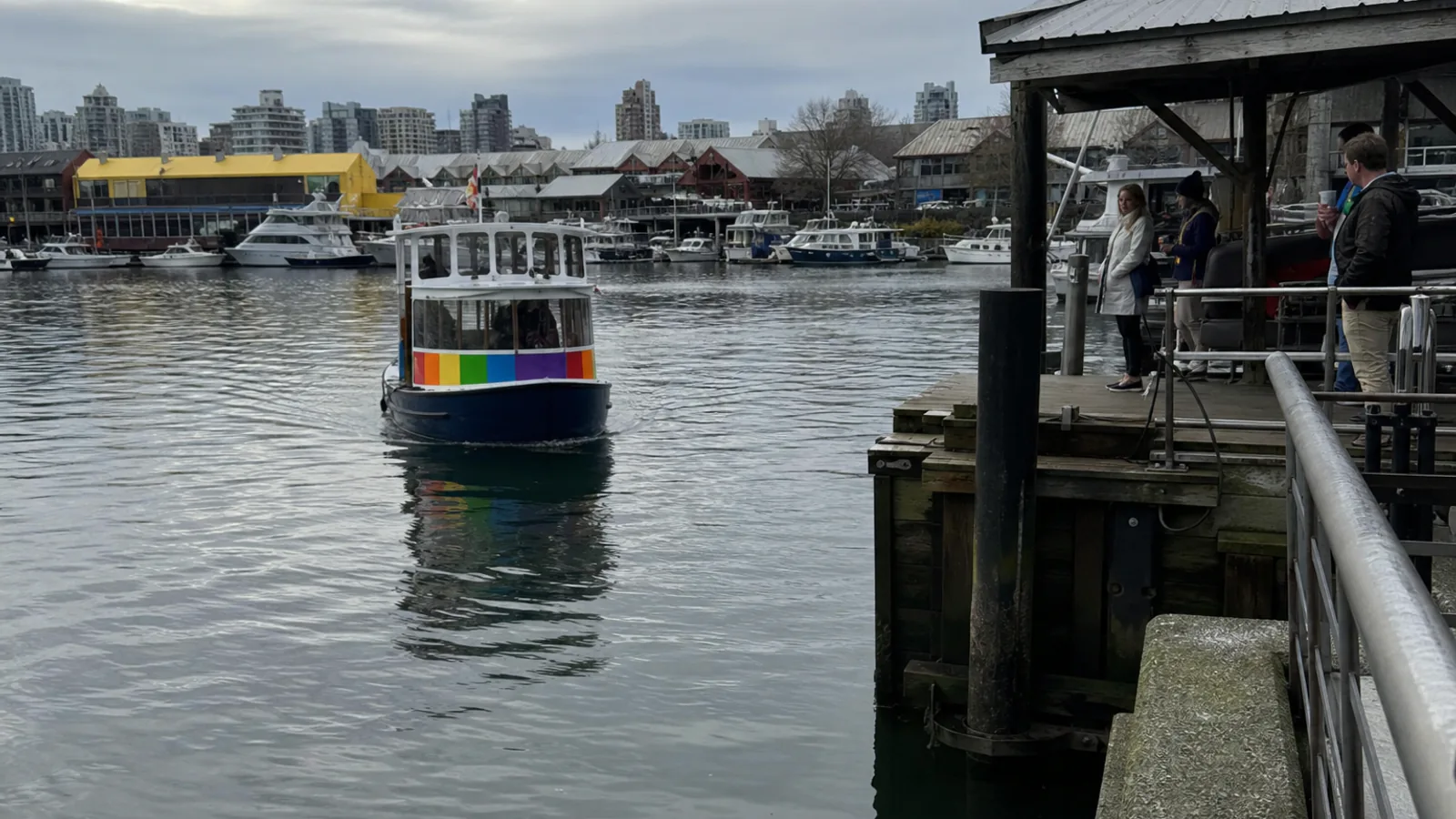
The crossing is the part people overthink. Two small ferry companies work False Creek, and for the Kitsilano side the one you want is False Creek Ferries, the little blue boats. They leave from the Maritime Museum dock at Vanier Park and run straight across to Granville Island, with departures roughly every fifteen minutes. The trip takes a few minutes, costs a few dollars paid on board, and runs year-round in any weather.
The other company, Aquabus, runs the rainbow-coloured boats from the downtown side, with its main dock at the foot of Hornby Street and frequent service to Granville Island. If you are starting downtown rather than in Kitsilano, that is the boat to take. Either way you land at the dock beside the Public Market, which is the whole point of going by water: you arrive at the market, not a parking lot. Both companies carry bikes and strollers, so the ferry does not lock you out of cycling the rest of the seawall afterward.
On a busy summer weekend, the Hornby Street and Granville Island docks tend to draw the longest lines, since that is the route most downtown visitors default to. The Vanier Park crossing is usually the calmer of the two, which is one more reason to anchor this loop on the Kitsilano side rather than queueing downtown.
You can also walk it. From Vanier Park, the seawall runs under the Burrard and Granville bridges to Granville Island in about thirty to forty minutes, flat and on the water the entire way. For the full picture of the seawall and the ferry network on both shores, see our False Creek guide. The ferry, though, is what makes the two halves feel like one trip.
Kitsilano: the beach, the pool, and the park
Kits Beach runs along Cornwall Avenue from around Arbutus Street down to the point near Vanier Park. It is one of the wider sand beaches in the city, and English Bay is swimmable in summer if you accept that the water never truly warms up. Most people come for the sand and the sun more than the swim. The beachside courts keep up steady pickup volleyball through the season, and the seawall path from the beach to Vanier Park is an easy fifteen-to-twenty-minute walk.
If the timing lines up, the real draw is Kitsilano Pool. It is a heated outdoor saltwater pool right beside the beach, and at 137 metres it is the longest pool in Canada, long enough for real lengths rather than splashing. It opens for the summer season; the City of Vancouver posts current hours, season dates, and admission, which are the figures to check before you build a day around it. There is drop-in recreational swimming alongside the lane swimming, and the deck alone is a full afternoon on a hot day. Beside the pool, the Kitsilano Showboat puts on free outdoor performances on summer evenings, a low-key local fixture that has run for decades.
At the far end of the beach, Vanier Park is the open green where the city’s summer Shakespeare festival, Bard on the Beach, sets up its tents from roughly June through September; the festival’s site carries the schedule and tickets. The same park holds the Museum of Vancouver and the H.R. MacMillan Space Centre, and on a clear night it is one of the better free sunset spots in town. Our guide to planning a day at Bard on the Beach or the Vancouver Folk Festival covers timing, tickets, and how to build an evening around the park.
West 4th, if you have the time
Behind the beach, West 4th Avenue is Kitsilano’s main commercial strip, at its densest between Burrard and Balsam. It is a useful place to handle coffee or a meal at either end of a beach afternoon. KAHVE has a steady local following for espresso, and the 49th Parallel cafe draws weekend lineups largely for the Lucky’s Doughnuts counter inside it.
For something more substantial, the strip has turned over toward quality over the years and runs from casual to proper sit-down. The Naam, further along West 4th, is a long-running Kitsilano vegetarian restaurant dating back to 1968; its hours have shifted over the years, so check before you count on a late one. None of this is essential to the route, but it is the difference between a quick beach stop and a full afternoon.
Granville Island: what locals actually buy
Granville Island holds an odd position for a place this busy. It is one of the most-visited corners of Vancouver and also somewhere locals genuinely shop, and those two facts sit awkwardly together on a July Saturday and comfortably on a Tuesday morning. Timing is most of the game.
The Public Market is the heart of it: somewhere around fifty vendors under one roof, free to walk into, selling produce, seafood, cheese, baking, and prepared food. The things actually worth your money are easy to name.
Lee’s Donuts has been in the market since 1979, and its old-fashioned cake donuts are why the line runs out the door on weekend mornings. Arrive on a weekday before ten and you walk straight to the counter.
The seafood counters are the serious business of the market. Several vendors sell whole salmon and halibut, smoked fish, and live crab, and during the short BC spot prawn season, which usually runs from May into the early summer, this is one of the better places in the city to buy them fresh. Steveston in Richmond sells prawns straight off the boats in the same window; our Steveston guide covers how to time that trip.
For anyone cooking rather than sightseeing, the cheese vendors and the BC produce stalls are the other reason to come here specifically: Fraser Valley berries, Okanagan stone fruit, and the kind of summer tomatoes and corn that make the rest of the year’s produce look apologetic. Many of the same growers sell at the region’s weekend markets, mapped in our guide to Metro Vancouver farmers markets.
To eat on the spot, the market’s prepared-food stalls handle sandwiches, soup, fish and chips, and pastries. For a sit-down lunch with a view, the Dockside Restaurant at the Granville Island Hotel has a waterfront patio across False Creek, where part of what you pay covers the outlook.
Past the market
The market pulls the crowds, but the rest of the island is the quieter half and often the better one. The Net Loft and the studios scattered around the island house working potters, jewellers, and textile makers, and that is the least touristy and most interesting part if you care how things are actually made. Near the Kids Market at the south end, there is also a free public water park, which is a useful card to have on a hot afternoon if you are doing this with children.
Granville Island Brewing, which opened in 1984 as one of Canada’s first craft breweries, keeps a taproom and patio on the island. The Arts Club Theatre runs a year-round stage here too, so a show paired with dinner is one way to stretch the visit into the evening, if you are not hurrying back across the water for the sunset.
What to skip when you’re short on time
If you only have a few hours, cut rather than cram. Skip the car: parking on both sides is the most stressful part of the day, and the ferry erases the problem. Skip the market on a Sunday afternoon in July, when it is at its most crowded and least pleasant; the vendors are identical at nine on a Wednesday and the experience is not. You do not need both a West 4th sit-down and a full market graze in one trip, so pick the one that suits your appetite. And the more generic prepared-food stalls are easy to walk past, because the market earns its name on raw ingredients far more than on its food court.
When to go
The honest answer is a weekday morning. The market is calm, the ferry is not backed up, and Kitsilano in the early afternoon still hands you the beach. If a weekend is your only option, reach the market early, by around nine, and let the day slide toward Kitsilano as the crowds build behind you. On a hot day, lead with the swim and treat the market as the cooler indoor half. On a wet one the loop still holds up, since the market and its food are all under cover and the ferry runs regardless. The ferry ride itself is a small event for younger kids, which makes the whole loop an easier sell than one long museum visit. And if you want one image to carry home, run the loop so you finish at Kits Point as the sun drops over English Bay.
Doing it without a car
The day is better without a car, and it is built to work that way. For Kitsilano, buses 2 and 22 reach the beach area from downtown, while the 4, 44, and 84 run the West 4th corridor; TransLink has the current routing. Granville Island is the harder side to reach by transit, with no SkyTrain onto the island and only the number 50 bus stopping near the entrance, which is exactly why the ferry is the standard way in.
Cyclists have it easy: the Point Grey Road and Cornwall bike route runs the length of the Kitsilano waterfront and ties into the wider seawall network. If you do drive, know that the Kits Beach lots fill by late morning on summer weekends and Granville Island’s parking is limited and time-restricted, so neither side rewards a late start. Our guide to beach parking around the city has the details if you are set on driving.
The short version
Taken separately, Kitsilano and Granville Island are each a decent way to spend a few hours. Taken as one loop with the ferry in the middle, they add up to a half-day that covers a beach, a saltwater pool, a public market, and a sunset without once asking you to find parking. Fold it into a wider Vancouver weekend and it sits neatly inside the rest of the trip.
Travel details change. YVRBlog aims to use official sources and show the review date above. If something has changed, please contact us.